
Upper limb rehabilitation equipment list

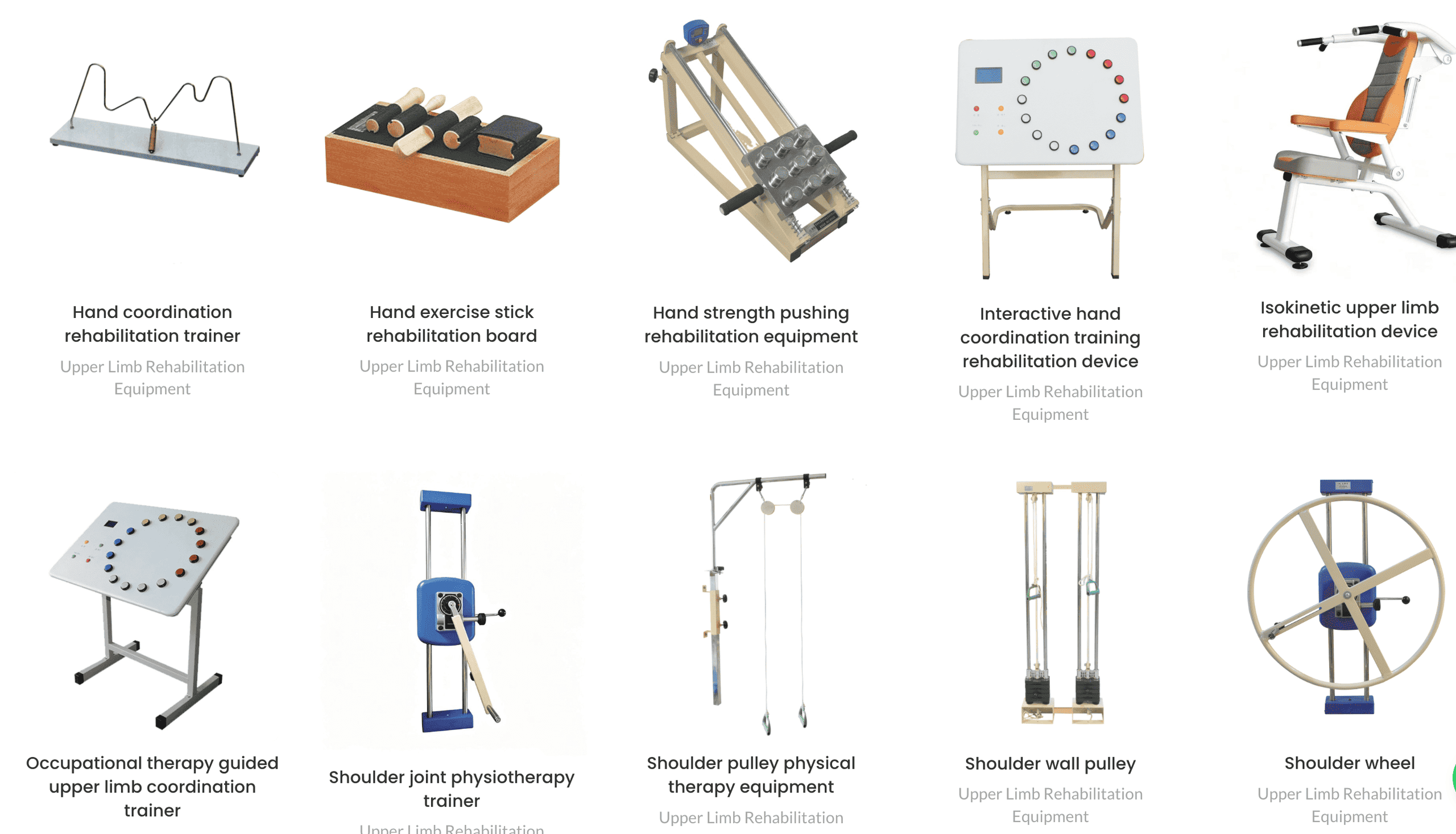
Upper limb rehabilitation equipment includes shoulder wheel, wall bar, shoulder ladder, rotation device, elbow exercise rehabilitation chair, shoulder CPM…
How to choose upper limb rehabilitation equipment for yourself?
There are many types of upper limb rehabilitation training devices. Based on training objectives, they can be roughly divided into several major categories: range-of-motion training, muscle strength recovery, fine motor function, mirror therapy / virtual reality rehabilitation, and early bedside rehabilitation. The selection depends mainly on whether the patient is in the flaccid paralysis stage, spasticity stage or recovery stage, and whether active or passive training is required.
I. Range of Motion and Passive Training Devices
- Upper Limb CPM Machine (Continuous Passive Motion Machine)
It is used in the postoperative or early weakness stage. The machine drives the shoulder, elbow and wrist to perform regular flexion and extension.
Suitable for rotator cuff repair, elbow joint postoperative rehabilitation and early stroke care to prevent joint stiffness.
- Shoulder Rotation Trainer
It can be fixed on a wall or column. The user rotates the handwheel to perform shoulder circumduction.
Mainly used to improve frozen shoulder and limited shoulder mobility.
- Pulley and Ring Trainer
The unaffected hand pulls the rope to lift the affected upper limb.
Suitable for patients with insufficient shoulder flexion and abduction range.
- Upper Limb Training Table / Finger Splint
Finger splints relieve finger flexor spasm and prevent stiffness.
Training tables equipped with pegs, ring sets and other components can be used to train shoulder, elbow and wrist coordination.
There are various upper limb rehabilitation devices classified by training parts such as joint mobility and muscle strength. To help you accurately match suitable equipment, please quickly answer a few questions. Is the upper limb rehabilitation training for the hand, elbow or shoulder?
Hand
Elbow
Shoulder
II. Muscle Strength and Resistance Training Devices
- Resistance Bands / Resistance Tubes
The most practical home-use equipment for shoulder external rotation, elbow flexion and extension, and wrist dorsiflexion.
Available in different resistance levels for gradual training during recovery.
- Sandbags / Dumbbells / Wrist Weight Cuffs
Attached to the wrist or forearm for gravity-resisted exercises such as arm lifting and elbow flexion.
Suitable for patients with muscle strength of grade 3 or above, starting from 0.5 kg.
- Upper Limb Pushing Trainer
A seated push-pull device to strengthen shoulder press, chest push and rowing movements.
Commonly used in rehabilitation departments and community rehabilitation centers.
- Hand Grip Strengthener / Finger Exercise Ball
For grip strength training and improvement of hand muscle strength, suitable for late-stage hemiplegia and peripheral nerve injury recovery.
What is the current upper limb muscle strength: Grade 0–2, Grade 3, or Grade 4?
Grade 0–2
Grade 3
Grade 4
III. Fine Motor Function and Occupational Therapy Equipment
- Occupational Therapy Kit (OT Kit)
Includes pegboards, screws, ring sets, peg discs, etc., for training grasping, finger opposition and hand-eye coordination.
- Finger Ladder Trainer
Fingers climb step by step to train finger flexion and extension range and active control.
- Pinch Ball / Modeling Clay / Spinning Top
Used to train thumb opposition and fingertip pinch strength.
- Activities of Daily Living Simulators
Such as simulated door handles, taps and button panels to train practical daily functions.
Is the main problem of upper limb fine function difficulty in grasping, finger opposition, or daily operation?
Difficulty grasping
Difficulty in finger opposition
Difficulty in daily operation
IV. Mirror Therapy and Virtual Reality Rehabilitation
V. Early Bedside Rehabilitation Devices
- Bedside Upper Limb Active-Passive Trainer (Bedside MOTO)
Installed beside the hospital bed. It provides electric assistance for circular pedal-like upper limb movements.
Suitable for bedridden patients with early muscle strength of Grade 0–2, with active, passive and assisted modes.
- Pneumatic Glove / Soft Rehabilitation Hand
Air pressure drives finger flexion and extension. Suitable for early patients with completely weak hands to prevent contracture.
Is the patient mainly bedridden, seated, or able to stand and walk?
Mainly bedridden
Mainly seated
Able to stand and walk
VI. Preliminary Equipment Selection Guide
- Complete immobility (muscle strength Grade 0–2): bedside passive trainer, pneumatic glove, CPM machine, finger splint.
- Able to lift limbs but weak (muscle strength Grade 3): pulley ring trainer, light-resistance resistance bands, mirror therapy.
- Able to resist partial load (muscle strength Grade 4): dumbbells, upper limb pushing trainer, grip strengthener.
- Focus on hand function recovery: OT kit, finger ladder trainer, pinch ball.
Intelligent Physiotherapy Equipment
Walking Rehabilitation Equipment
Upper Limb Rehabilitation Equipment
Lower Limb Rehabilitation Equipment
Whole Body Rehabilitation Equipment